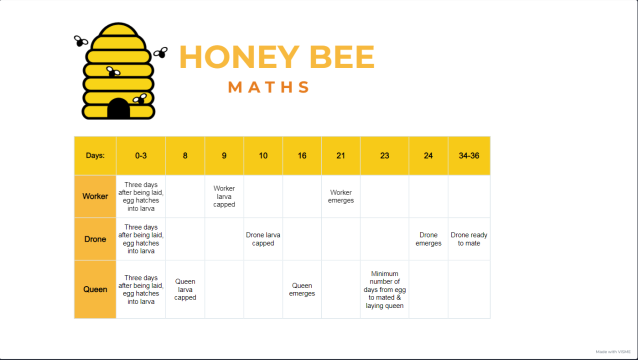
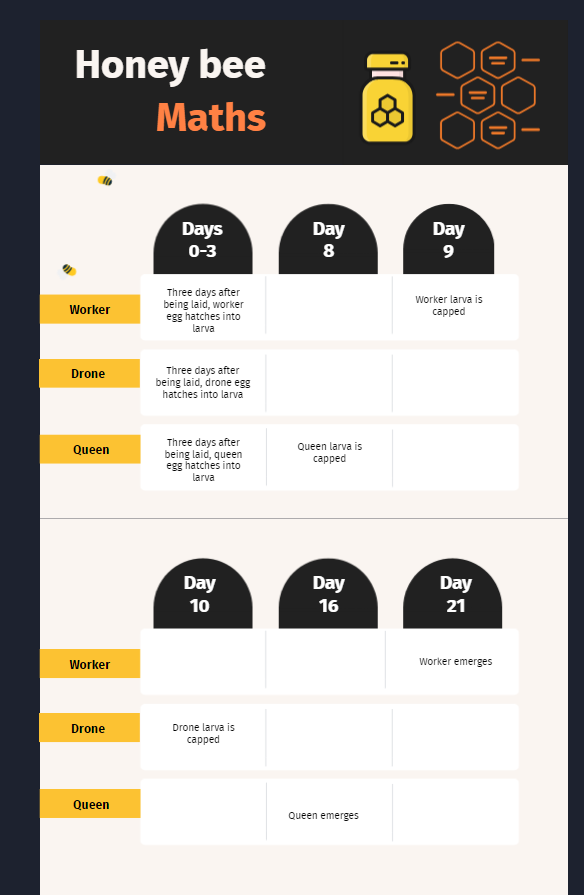
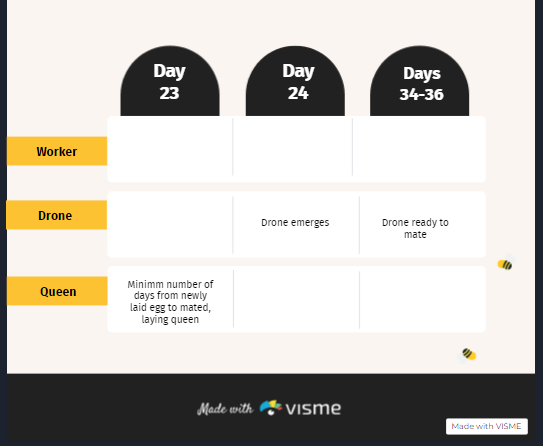
I’ve been doing some more playing around with the Visme infographic maker and produced these as a little reminder for myself of some ‘bee maths’. Memorising the number of days it takes for an egg to hatch, the larva’s cell to be capped over and the new bee to emerge is very helpful for a beekeeper.
For instance, if you see one egg at the bottom of the cell that tells you a queen has been laying eggs in the past three days (multiple eggs per cell might be either a new queen just getting started, or more likely laying workers).
These two charts below were my first attempt, before I discovered a more suitable template in Visme. I prefer the look of the charts below but think it’s more practical to have it all in one horizontal chart.
Many thanks to David at The Apiarist blog, whose post Timing is everything was very helpful for reminding myself of some of these timings!
Are there any more timings I should add in, that you find helpful when beekeeping?
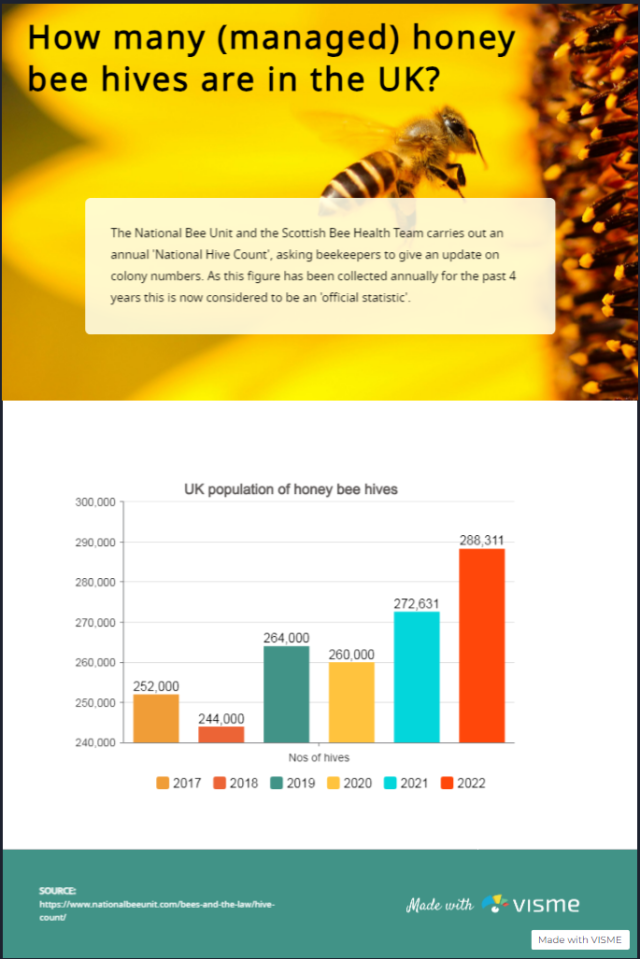
I’ve been playing around with Visme and made this infographic, based on hive count data from the National Bee Unit. This data is based on voluntary data supplied by UK beekeepers, so is likely to be an underestimate – but it’s hard to know how much of an underestimate! To give you an idea though, the British Beekeeping Association (BBKA) say they look after “28,000” hobby beekeepers, whereas in 2022 the National Bee Unit had 11,000 beekeepers complete the hive count. There are of course also feral colonies in places like old tree trunks and chimney cavities, but not many people are counting those.
I came up against WordPress wanting people to buy an upgrade before they can use JavaScript plugins, so I’ve just screenshotted the infographic and added it as an image! You can see the full version at: bee infographic.
Notes from a talk by Dr Stephen Fleming – co-editor of Beecraft magazine; he keeps his bees on Watership Down.
Back in October Stephen spoke to a group of us gathered for the Cornwall Beekeepers’ Association and West Cornwall Beekeepers’ Association annual conference. I meant to write about it sooner but then life got in the way!
It was a lovely talk, all about drone congregation areas (DCAs) – places high up in the sky where male bees (drones) gather to find queens. You can read Stephen’s perfectly named article ‘The Scilly game of drones’ on the Beecraft website, where he talks about whether drones will cross the choppy Cornish seas in search of a queen.
Stephen told us that the first person to document DCAs was the famous naturalist Gilbert White, in his diary ‘A Natural History of Selborne – Observations’ – 28 June 1792. He picked the sound up a year before his death, even when his hearing was bad. White could hear a loud audible humming of bees as he walked, without being able to see them.
The sound is still there today. A recording made by Stephen on the same down that White walked was played on Paddy O’Connell’s show, BBC Radio 4 (25th June 2017) – on the 225 year anniversary of Gilbert White hearing it. If you have a listen from 41 minutes in you will hear the incredibly clear sound of the drones.
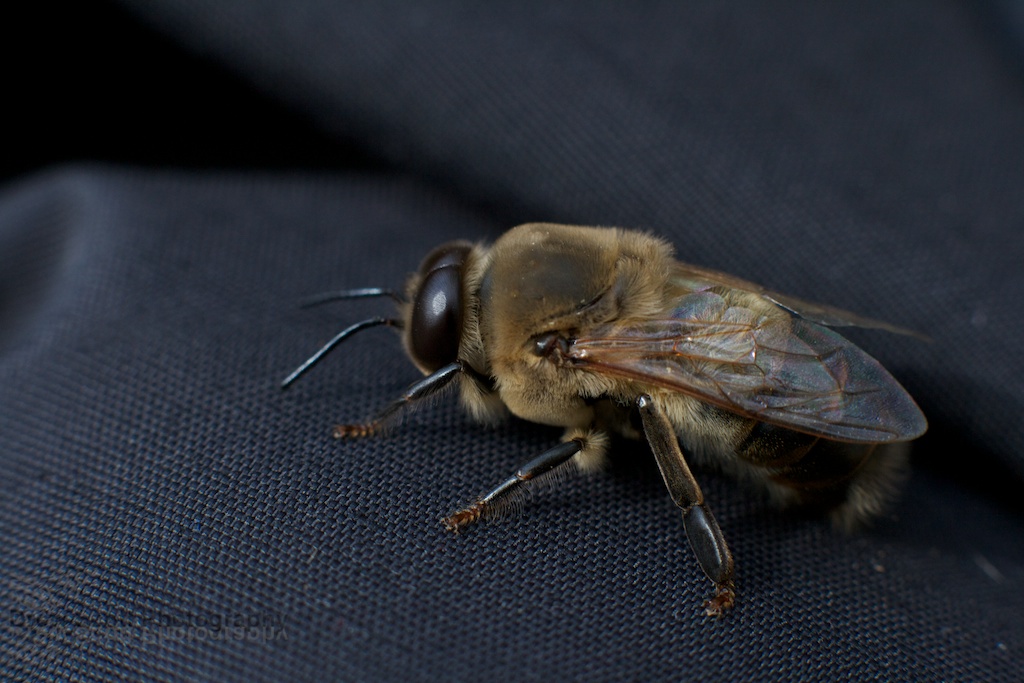
A handsome drone
It is believed RI Crowley in 1892 was the first person to realise that the phenomenon was a DCA.
The talk included a number of gorgeous clips of the drones flying in congregation. One was from ‘More than Honey’ (2012) by Markus Imhoof, which I’d forgotten I reviewed back in 2013! Stephen then went on to answer a series of questions he posed:
How do they know where to go?
How the drones choose a DCA is still a big mystery. There are a number of theories:
Magnetism?
Polarised light?
Light intensity?
Thermals – air rising up a slope?
Pheromone trails?
Don’t forget, drones only live a few months on average, so older drones are not showing younger drones where to meet. There must be some instinctive behaviour that lures them to these locations in search of virgin queens. Stephen feels thermals are at least one of the factors involved.
How many drones in a DCA?
Stephen mentioned that a formulae you can use to estimate the number of drones in a DCA will be in a Beecraft magazine issue soon. A couple of estimates he has made ranged between 1,782-2,045 in one area and 2,051-2,554 in another.
He went on to tell us how to go hunting for DCAs ourselves…
What you need
Synthetic 9-ODA, painted onto a queen cage (he said that unfortunately this is not easy to get, however you only need a tiny amount!) Or a spare caged queen
Extendable carbon fishing rod, 3-4 metres long
UAV drone (radio controlled drone)
Preparation
OS map
Google Earth
Knowledge of local apiaries
Look for grasslands rather than woods, as it is easier to see the DCAs without tree canopies
When to go
Stephen has found 3-5pm is the peak in the DCAs he visits in southern England, with the drones arriving first before the queens. However, other beekeepers he knows in Northumberland have said their peak time is earlier – around lunchtime. He feels it’s possible people researching DCAs may tend to generalise too much based on their own experiences, whereas there may be a lot of regional variations based on local geography.
In his experiences, the ideal summer’s day for DCA finding is 19C+ temperature, with a breeze. He will go out looking for them between 2-5.30pm. There are only a few of these ideal days each year. On days without a breeze he does not find DCAs; his theory is that drones prefer to fly into a breeze as it gives them better control over their flight.
Have you ever come across a DCA? It must be a wonderful sound to hear on a beautiful summer’s day.
It’s been a long time. A lot has happened. I’ve moved house. I’ve sold my bees, caught a swarm, given that away, nearly given up on bees completely, and then started going to meetings at my local association apiary, about twenty minutes drive away in mid-Cornwall.
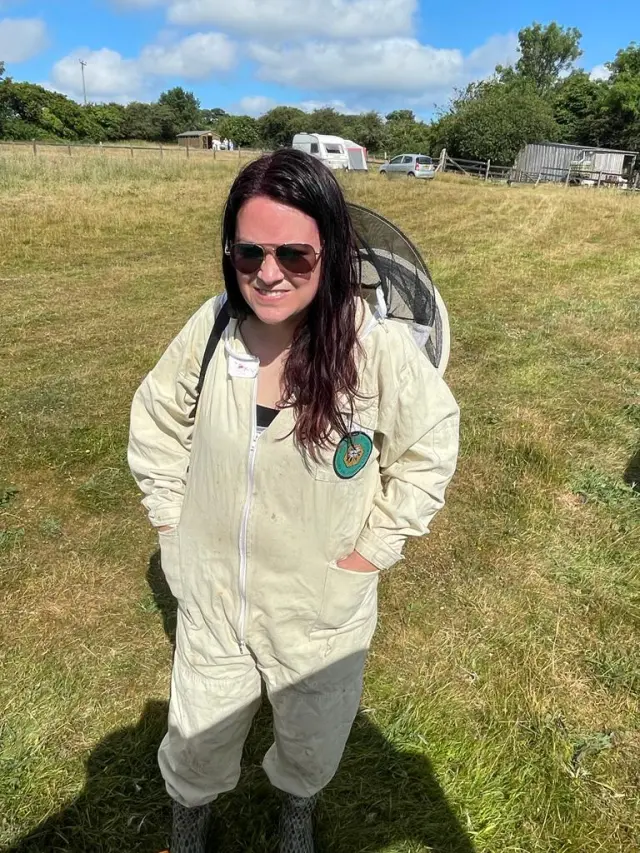
Back in my suit!
I miss my bees and it’s been fantastic watching the bees being inspected. Two weeks ago I spotted a new queen and one of the tutors marked her in this year’s colour, red. I’ve now been asked to become a tutor myself and show complete beginners inside a hive, taking them through the basics of the differences between worker, drone and queen, the parts of the hive, and how the colony works.
The apiary sessions remind me of the lovely Ealing apiary, with its friendly bunch of beeks and plentiful supply of cake. Yesterday we had both Victoria sponge and lemon drizzle, plus tea. The association has a good system where anyone who wants tea brings their own mug and then takes it home with them, avoiding one person getting stuck doing all the washing up afterwards!
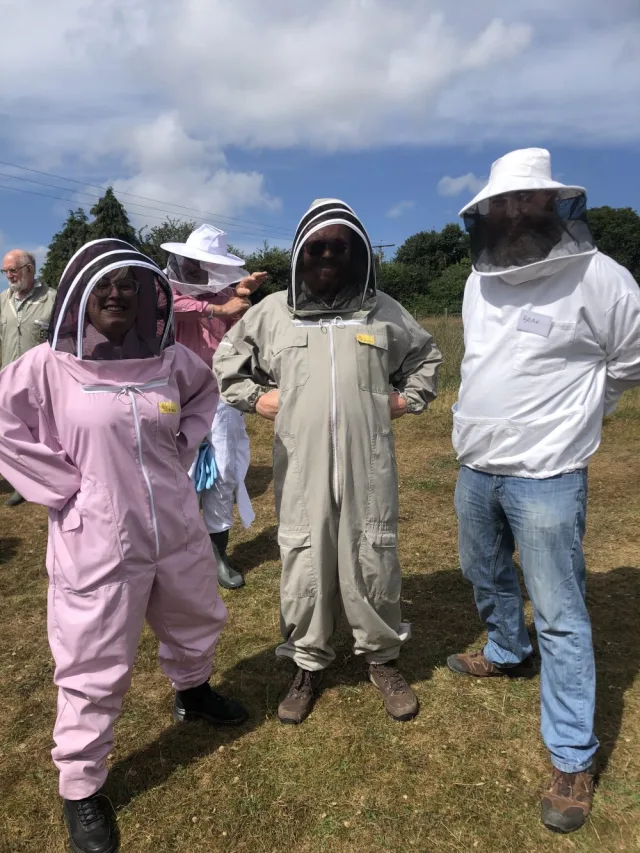
Newbee friends of mine
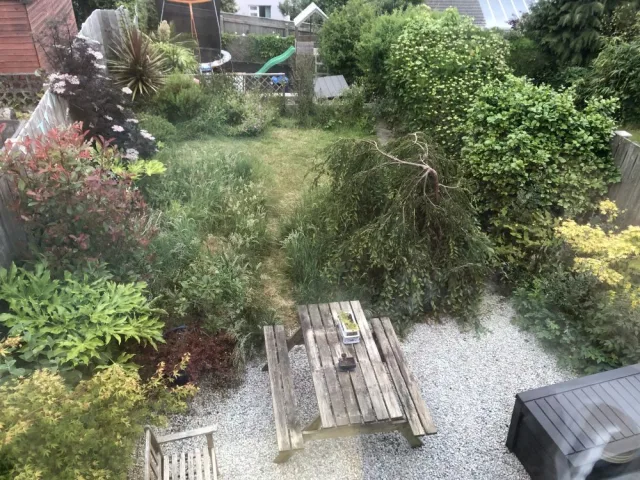
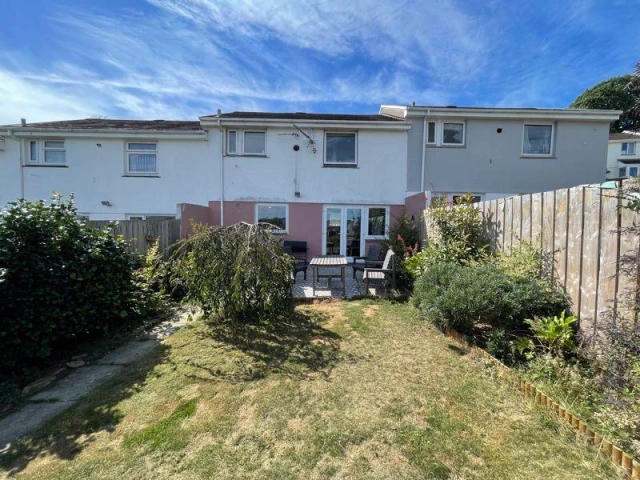
I’ve also been trying to make my new back garden more bee and wildlife friendly. I’ve let parts of the grass grow long, and been rewarded by the sight of butterflies dancing over it. The butterflies seem particularly fond of some long grass I have in my similarly sized front garden. After just six months of not cutting it, wild strawberries, plantains, foxgloves and yellow rattle are growing there.
Back garden – now
Old back garden – last autumn
I took the bottom photo in September last year – nearly a year later, many things have almost doubled in size!
I bought some plants from Rosy Bee, a UK company who specialise in plants for pollinators. I have a bare but sunny bit at the top of my front garden which has really poor soil, so I thought I might as well try some wild flowers out there. I got the beautiful sea Holly, Lambs ear (a fave from my old house) and Ox eye daisy as it’s known for being a tough plant that’s good at filling space. I also found out one of my neighbours is a gardener who sells plants, and she has supplied me with rosemary, Michaelmas daisies and sage.
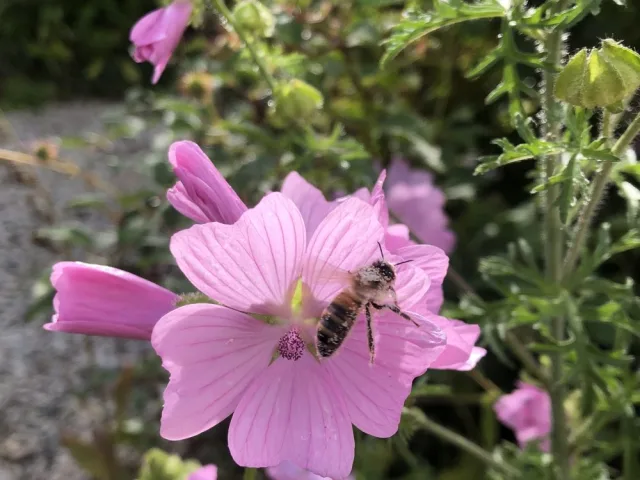
The front garden already had a large patch of mallow flowers, which both honey bees and bumbles have been enjoying. It leaves them with a dusting of white pollen on their backs.
Honey bee on mallow flower
After a stressful couple of years, I am starting to get the buzz back for this special hobby 🙂
A couple of months ago, I put a bait hive out in my garden. An empty National brood box, apart from a dark old brood comb pushed to one side and some lemongrass oil smeared on the walls. Then I waited.
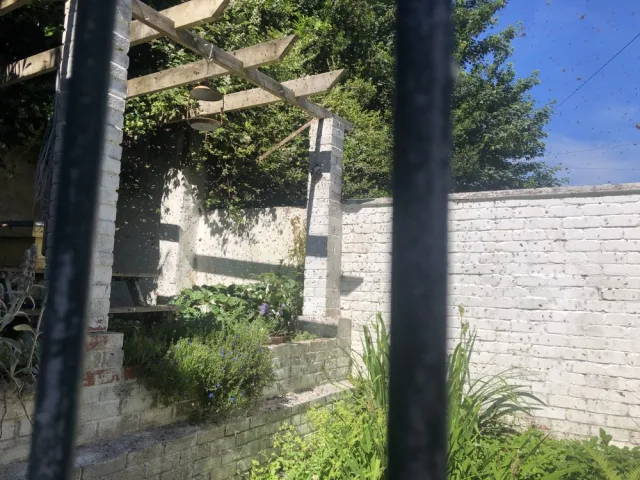
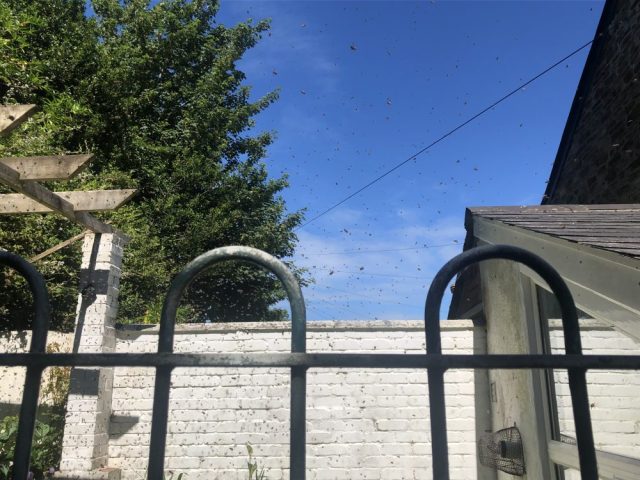
At first… nothing. But then… I saw some bees coming in and out, inspecting the empty premises. The next day, it was clear something was afoot. More and more bees could be seen around the entrance, until the air in my garden was filled with masses of humming bees. I went and stood outside, looking at the sheer number of them. You can see them against the white wall in the photos below.
The swarm descends
Bees fill the air
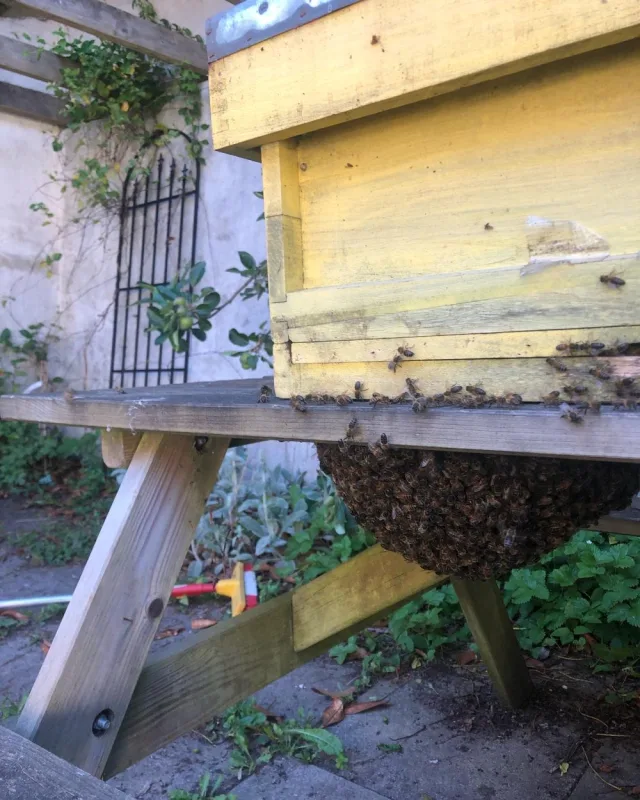
But often life is not easy, and so this was not quite as simple as I was hoping. The bees had come to me – fantastic – but they’d also landed not inside but under the bait hive.
Swarm under the hive
The next day, I went out in my beesuit and attempted to gather them up. I used some highly specialist equipment for this job – a bee brush and a bucket. Although this was obviously an easy place to gather a swarm from, it still meant a bit of squeezing myself under the picnic table, hovering holding the bucket with one hand while brushing the bees in with the other as gently as possible.
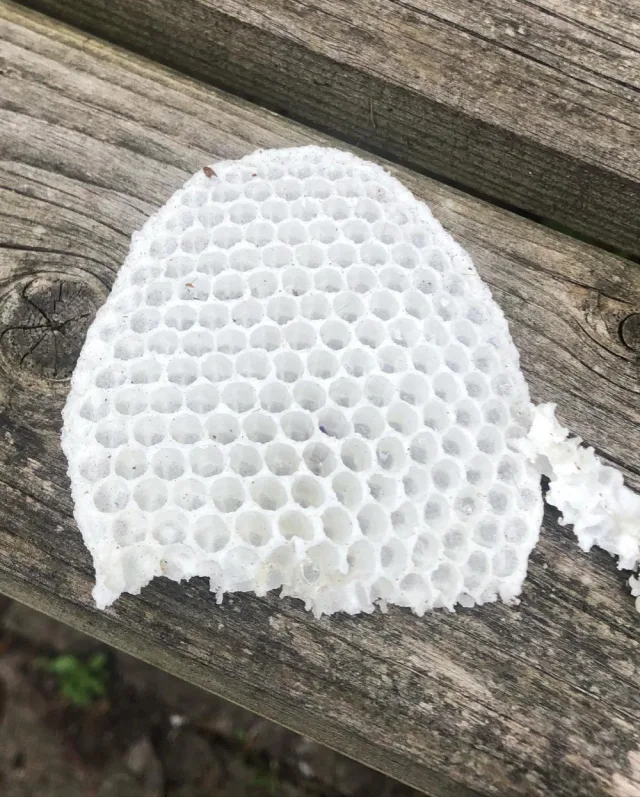
Just in the space of about 24 hours, they’d made the beautiful, pristine comb below, which the swarm was gathered on under the table. The wax is produced by glands in their abdomen, which they then chew and manipulate into the perfectly formed honeycomb shapes using their mandibles. Pretty amazing when you think about it.
Freshly made new comb
My first attempt failed and the bees quickly reverted to hanging out under the table. I realised I must not have gathered up the queen, so they had all returned to her.
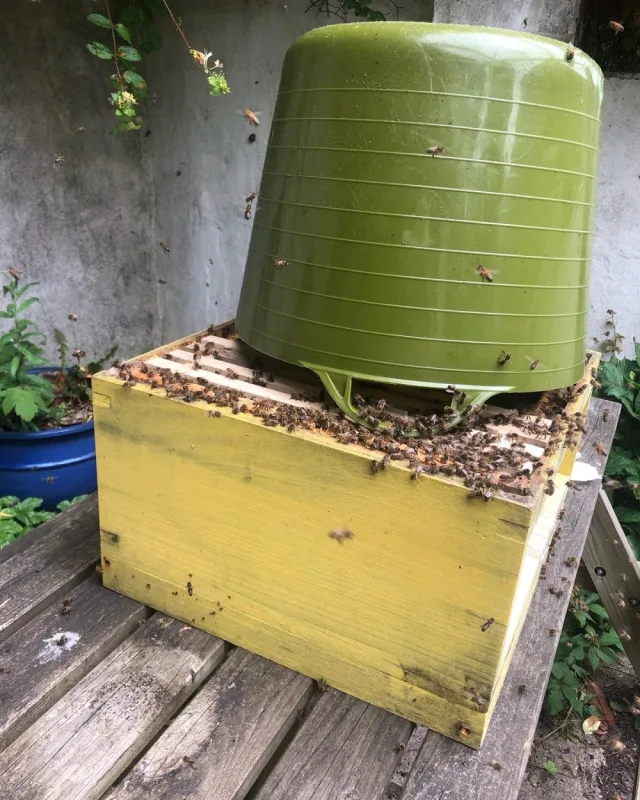
On my second attempt, I tried to make sure to get almost every single bee. This time the bees lined up on top of the frames, lifted their bottoms and fanned their Nasonov glands, which I took as a good sign. They were telling the other bees that this was now home.
Putting the bees in the hive
A couple of months later, the bees are still here. I have named the new queen Lowen, which means ‘Joyful’ in Cornish.
Some photos of the flowers I’ve seen out and about in Cornwall and in my garden over the last couple of weeks. I like to see what’s in flower and available for the bees.
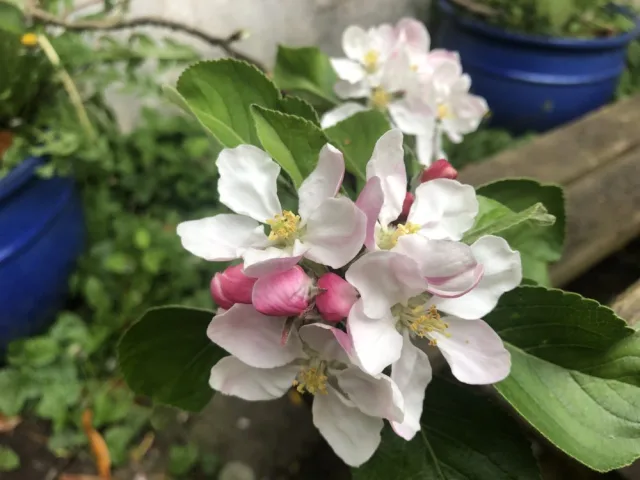
Below is my miniature apple tree. I mainly see hoverflies and bumbles visiting this. Honey bees tend to favour big collections of one type of flower, so this wee tree is probably not worth it for them.
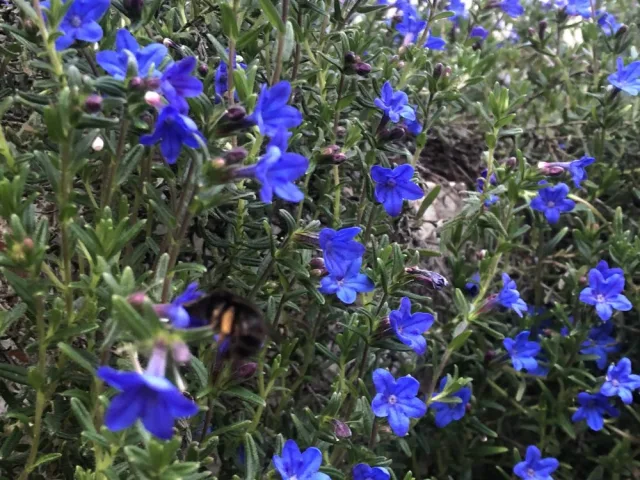
One of the first bees of the year I see in my garden is the enchantingly named female Hairy-footed flower bee . I always see them on the deep blue flowers of lithodora, which they will visit all day until the early evening. I say ‘see’ them but I usually hear them first, as they’re noisy little bees and very fast, efficient movers – which is why my photo is blurry!
Female hairy footed flower bee
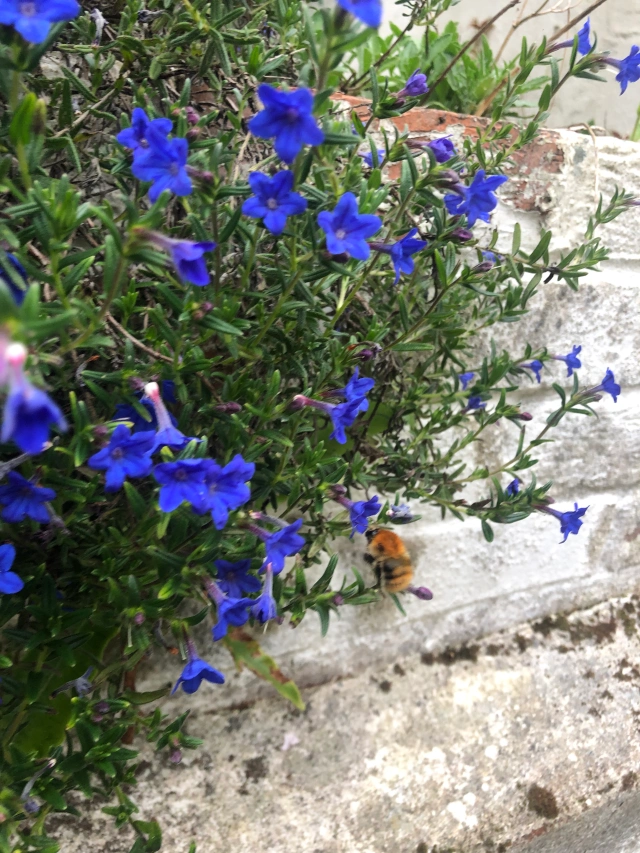
Below is the male hairy footed flower bee, which I first start seeing a couple of weeks after the females. They visit the lithodora flowers too.
Male hairy footed flower bee (Anthophora plumipes)
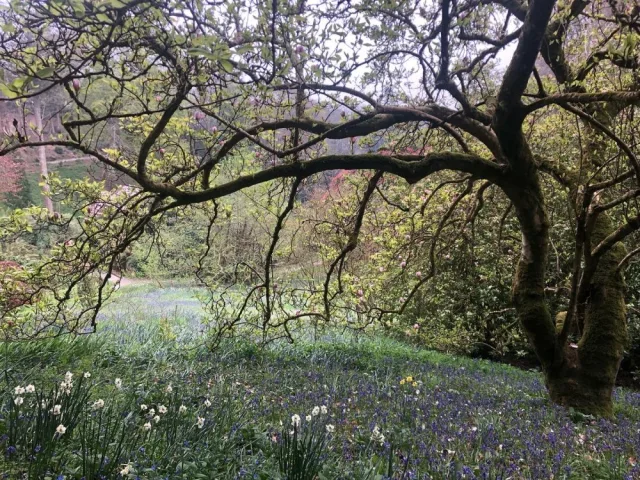
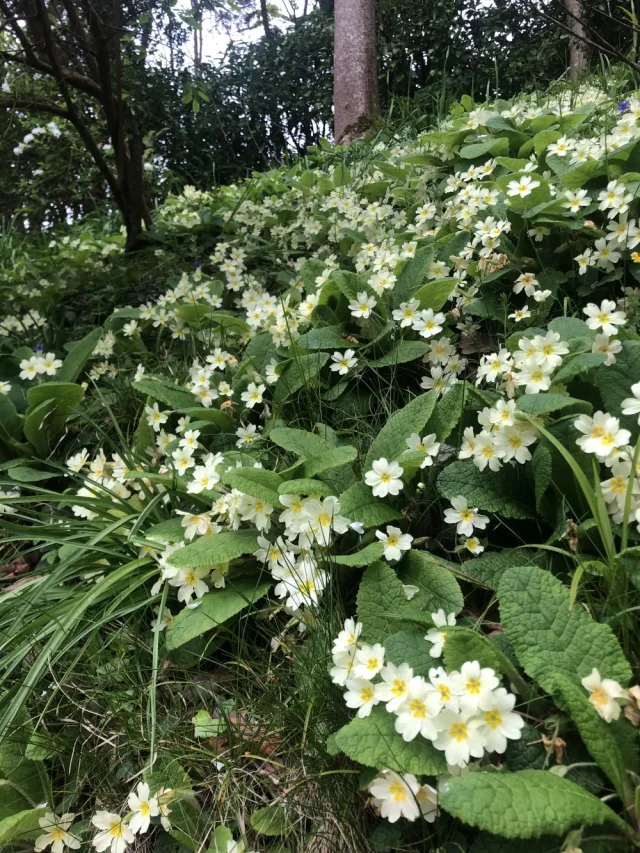
Bluebells, daffodils and primroses grow in profusion in Cornwall. I can’t recall seeing as many primroses anywhere else I’ve lived in the UK. Most of the primroses are yellow, but there are some pink blooms too.
Bluebells and daffodils
Primroses
I went for a walk along the coast by St Mawes, where a variety of white flowers decorated the verges.
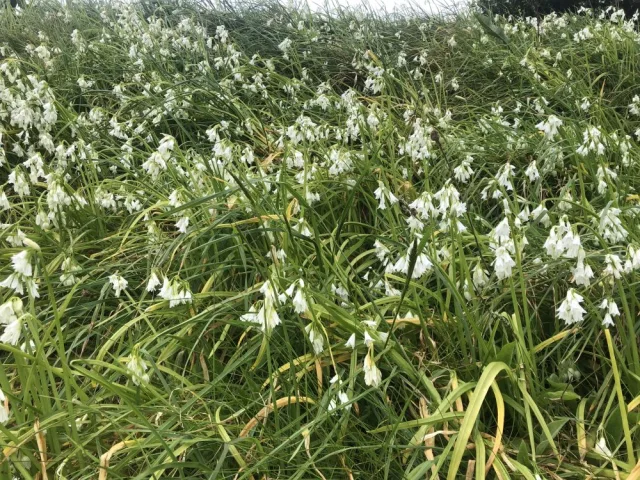
The ones below are not wild garlic, although they smelt very garlicky! Wild garlic flowers have a more star-like, upright shape.
Three cornered leek
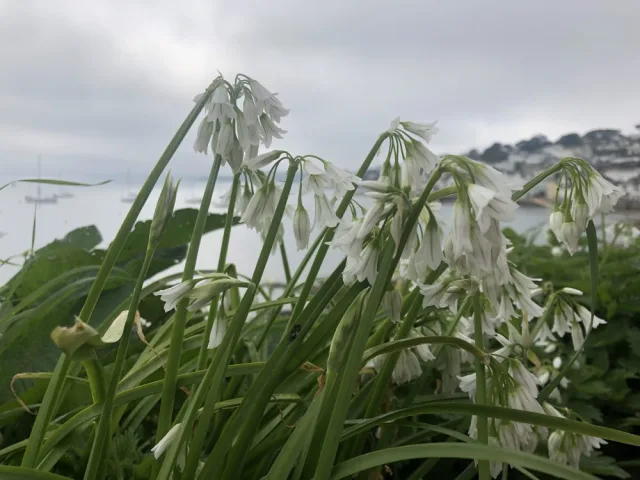
Think these flowers below are three-cornered leek, which can be identified by the green stripes inside their flower. An edible plant which can be used like spring onions.
Three cornered leek
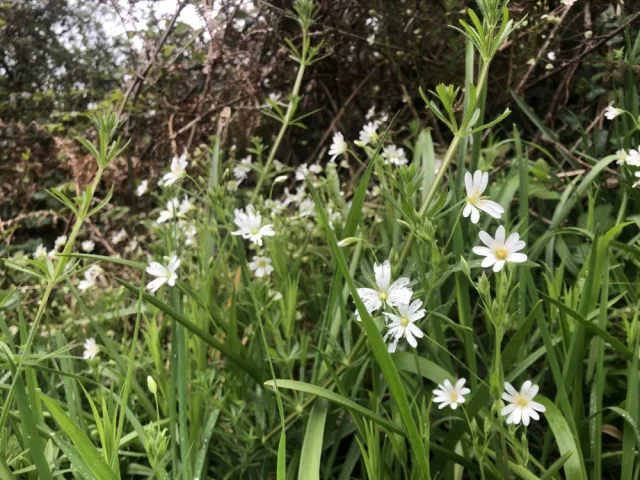
Below are stitchwort flowers, these grow along hedgerows and in woodland
Stitchwort
Sadly my bees, having survived the winter, somehow became queenless around March. I’m now bee-less for the first time in years. I will probably put out a bait hive soon as the bee year is beginning again. I still answer emails for my local association and the queries about swarms and bees in chimneys are just starting!
And so we’re in 2022… another year for us… but the first and only winter for my bees. Huddled in their nest, resting their wings, winter bees tend to live longer than summer bees. But still their life-span is measured in months, not years.
On any dry day this winter, my colony has continued to be active, flying and finding yellow and orange pollens. In the photo below (taken a week or so ago) I’ve found one returning with bright orange pollen. I’m not seeing much in flower, so am not sure what this might be. Possibly willow or mahonia? Gorse flowers all year round here, but I rarely see bees on that. Bristol beekeepers have a good pollen guide showing the UK pollens available in different seasons: Pollen guide
I did an oxalic acid trickle over the Christmas holidays to treat for varroa (the bees were not feeling in a Christmassy spirit towards me!).
They still have plenty of fondant up above the crown board. I see some of them nibbling away at it when I check on them every couple of weeks. I also find wood lice and the occasional slug enjoying the warmth above the colony.
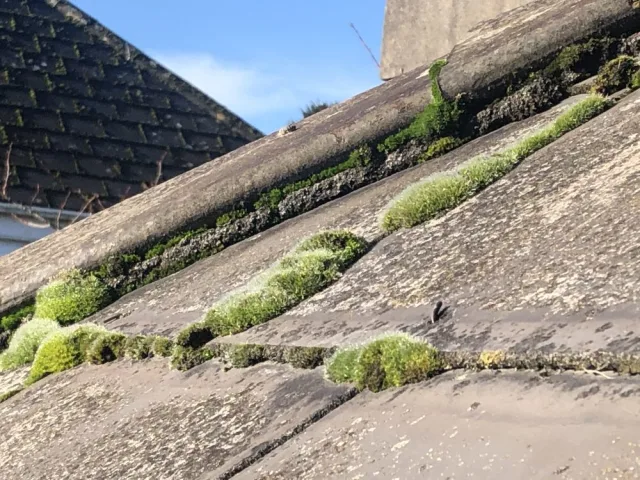
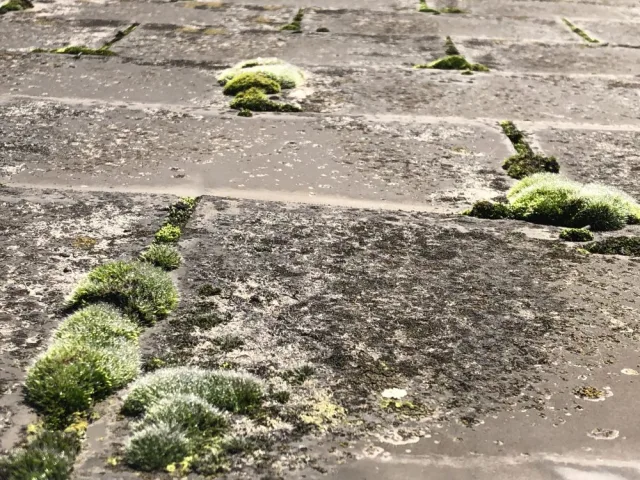
Something that surprised me recently was seeing honey bees visiting the moss on my roof. From my attic window I can lean out and see the different mosses up close. I’d never paid much attention to moss before, just seeing it all as soft green lumps. It took me a little while to realise that actually a few different species live up on the roof, with a variety of velvety textures and shapes you would never guess at looking up from the ground. This side is south facing and so even in these chilly winter months some of them appear to be flowering, with tiny light green flowers sticking up on stalks.
Were the bees finding tiny amounts of nectar? Or perhaps drinking from water collected in the moss? It’s hard to know.
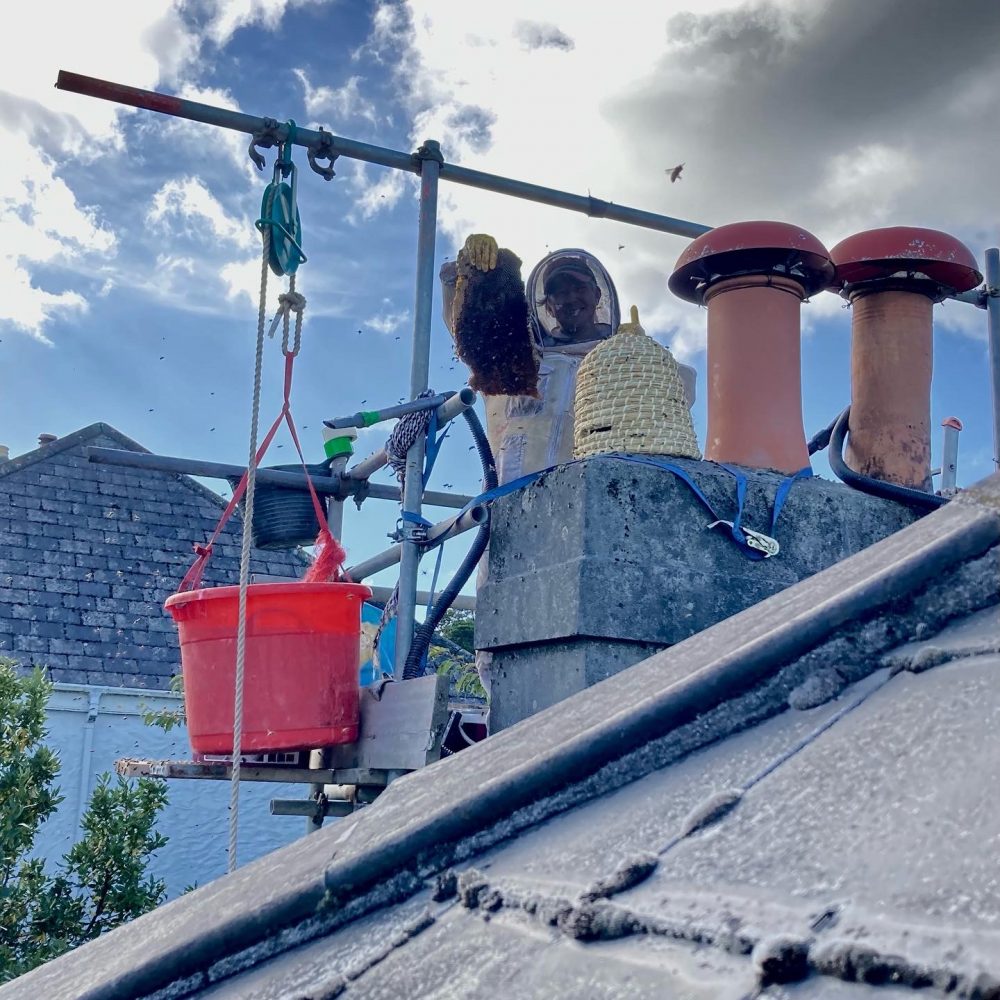
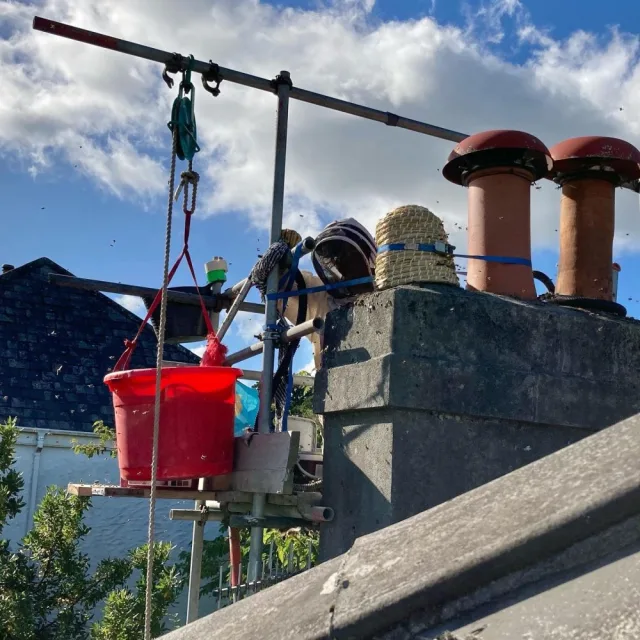
Some of my longer-term readers may remember that I had bees in my chimney stack. This had turned into a tricky problem, with quotes of £4,000+ to remove them and reseal the chimney. It wasn’t even my fault (honestly!!) as when the swarm first moved in my own bees were based around four miles away. The bees just found me.
Well, I found a solution! I joined a Facebook group called UK Bee Removers. Where I then noticed a lady called Molly from Bees Off based in Cornwall. I’m so pleased to have found someone local, who could do the whole job for us. She organised all the scaffolding and rehomed the bees in her own apiary based in central Cornwall. She then resealed the tiny crack in the chimney stack where the bees had got in, so that it won’t happen again.
Molly from Bees Off
She’s also got a cracking sense of humour and was very patient with all Tommy’s (many!) questions – “Why do you have a ladder?” “What are you doing up there?” “Where are the bees going?”. She showed him how he glowed red with her heat sensor, which she uses to determine exactly where the bees are in the chimney. She also uses a special honey bee vacuum, putting the sucked up bees back onto their comb (rubber banded into frames in a nuc) part way through.
She said this was a whopper of a colony with combs hanging down around four feet, they’d been really thriving up there! Was a shame to kick them out in a way but I did want to use my fire again!
I’d left some equipment behind in the old location I used to keep bees, and hadn’t got around to moving it yet. Some new visitors took advantage of this des res – a brood box with a few frames in, a floor, and an inspection board acting as a roof, all piled up on top of a load of empty equipment. They’re against a wall and have a hedge and trees the other side, providing shelter from the Cornish rain, and – in the last few days – the Cornish sun!
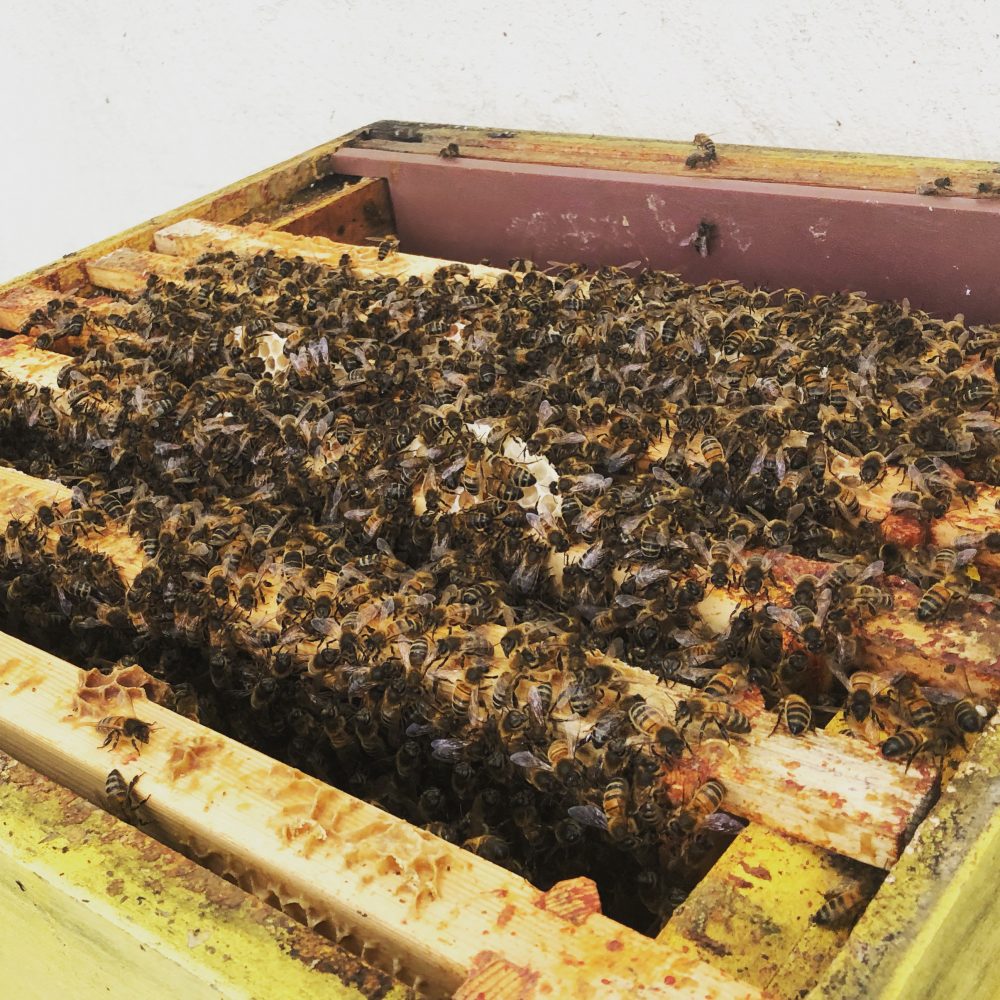
I was surprised at how large a swarm it was. A couple of weeks on, the brood box is full of bees. On my first inspection, I looked for eggs but found none. I filled in the empty spaces in the box with new frames of foundation. I inspected again four days later and was happy to spot larvae.
The next job to do is move them to the same location as my other bees. The swarm is especially lucky as my sole remaining colony, headed up by Queen Oilel (named by reader Disperser), seems to be queenless (or at least, she has stopped laying if she’s there). Sorry Emilio, your Queen didn’t last long.
The swarm before I filled in the gaps with frames
I discovered a few fat slugs living in the corner of the brood box, which I ejected for the bees, using my hive tool to pick them up and gently place them elsewhere. I then had to change my hive tool, as unfortunately I discovered bees get stuck to slug slime! Which is presumably why the slugs get away with it.
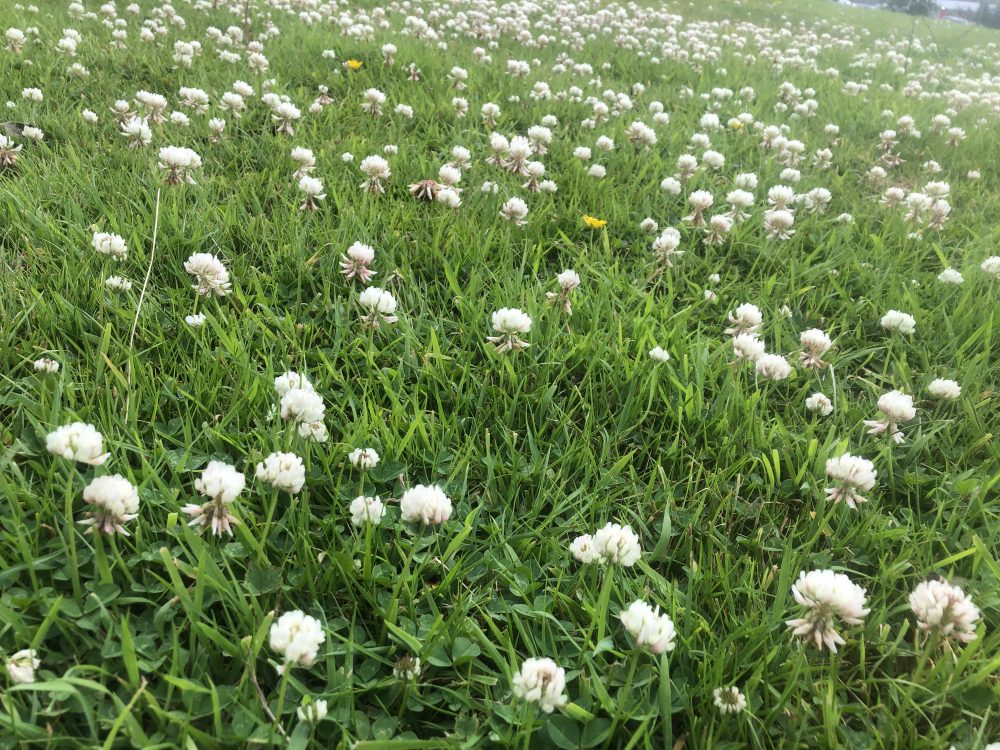
The bees have been taking advantage of the beautiful sunshine after the rain. On my last visit they had bulging light grey pollen baskets – I believe from blackberry brambles. Honey bees and bumbles can also be spotted enjoying clover at the moment.
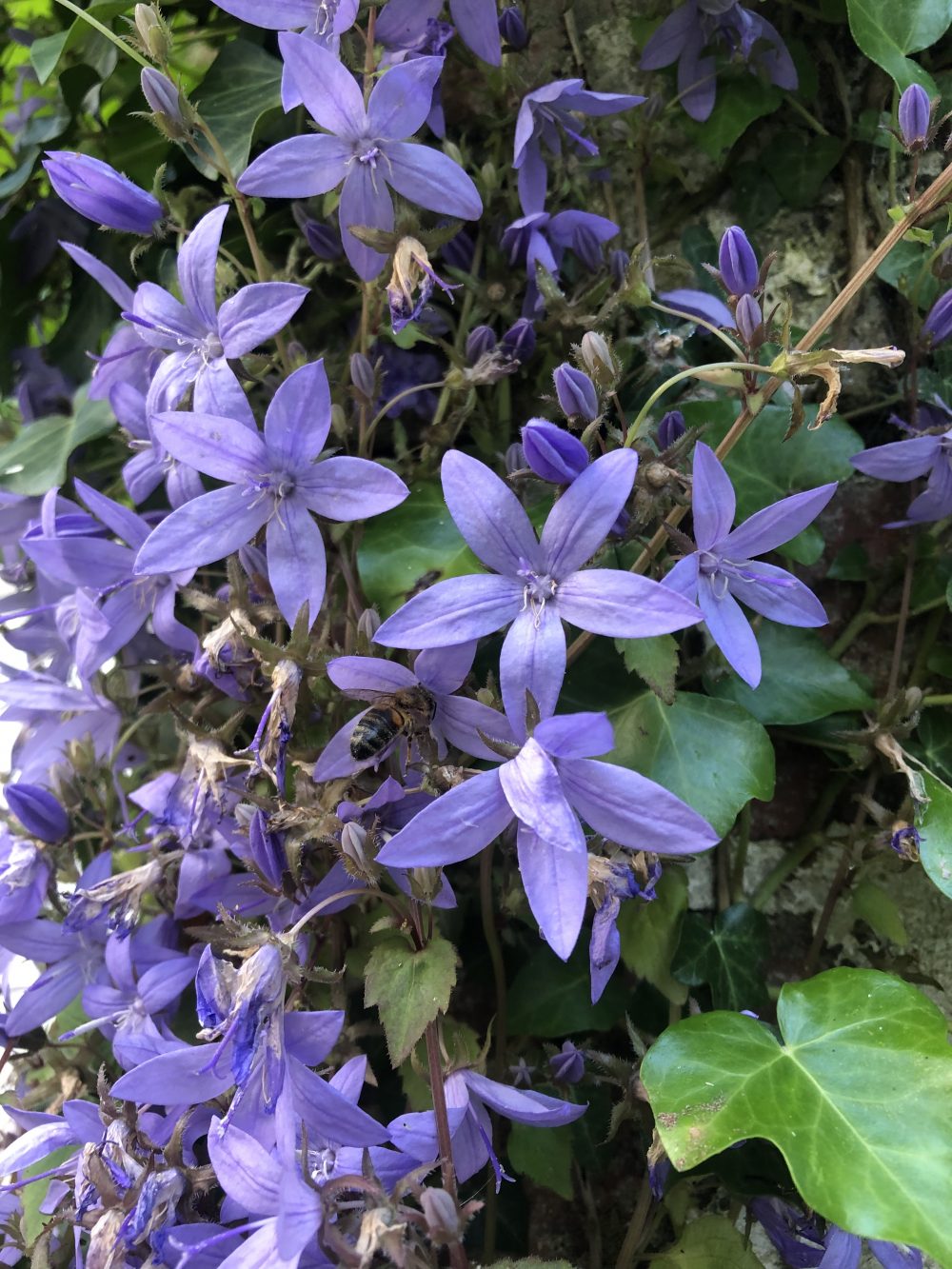
In my garden, campanula has been very popular, attracting honey bees but also more unusual small solitary bees a third of the size of the big honeys. If you look closely below you can spot a honey bee nestled in one of the flowers. The campanula self-seeds and drapes itself daintily everywhere, seemingly needing barely any soil at all.
A few weeks ago I moved my two little colonies in nuc boxes to a new location nearer to home. I’d never had to move bees before, so asked other beekeepers for tips beforehand and as luck would have it the BBKA News that landed through my door that day had an article all about moving bees.
The main thing with moving bees is make sure the bees can’t get out.
Earlier in the day I had put ventilated travel screens on top of both nucs, then left their roofs resting on them just in case it rained (it didn’t). Around 9pm, as the darkness of evening was drawing in, I returned and turned the dial at their entrance to the ventilation only setting. Very quick and easy. I had a kind helper with strapping the boxes together and moving them up to the car.
I haven’t been driving that long, and never with bees, so was a little nervous, particularly going over bumpy country lanes. I hadn’t anticipated the sound of the bees hitting the travel screen as they repeatedly flew up.
The roads I was driving down were very quiet at that time of night, so much so that for about the first fifteen minutes I only passed a couple of other cars. Was nice to be able to take it slowly without worrying about other drivers.
None of the bees got out, and they are now settled in nicely. One recently hatched queen is now laying and the other colony appears to be queenless, so I’m planning to combine them this week. I will need to think of a new Cornish name for the queen, a long dark beauty. Any suggestions?
As I was inspecting over the weekend I heard a sudden thud and something landed on the ground next to the hive. When I looked more closely, it was a baby bird, hairless and still. A baby blackbird perhaps. Its huge eyes were now permanently closed. I suddenly thought of my own children at a day old, so vulnerable and delicate. By the next day, its skeleton had been stripped to the bone. Somehow, life keeps going, and the remaining blackbirds keep flying.
 Adventuresinbeeland's Blog